
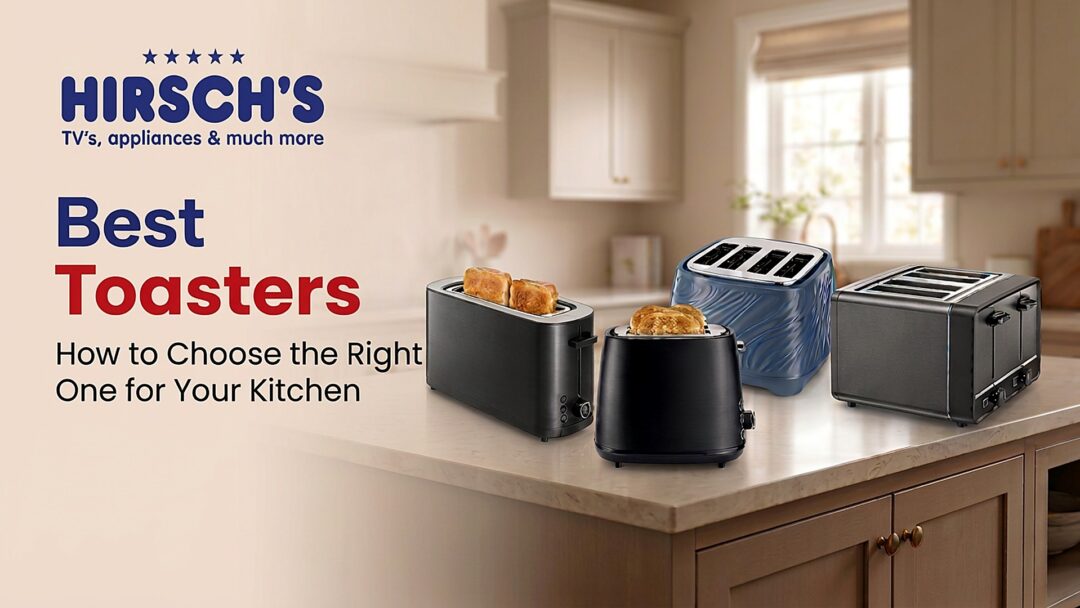
A toaster is one of those appliances almost everyone has in their kitchen, but we barely think about it until it starts burning one side of the bread or stops working altogether.
Replacing it should be simple, but the choice keeps growing.
The basic 2-slice and 4-slice toasters are still available. But long-slot designs, extra-wide slots for thicker bread, and premium models that match your kettle and stay on show have joined them.
Naturally, the best toasters still get the basics right. They brown consistently, are big enough for the bread you typically buy, and they don’t make breakfast more complicated than it needs to be. Hirsch’s range of toasters covers everything from affordable everyday models to premium designs. Premium means better build quality and a finish you’ll be happier leaving on the counter.
Our Pick of the Best Toasters
| Toaster | Best For | Type | Why It Stands Out |
| De’Longhi Ballerina Seta CTDS4003 | Best overall | 4-slice | Extra-wide, deep slots, extra lift and a distinctive premium design |
| Philips HD2637/91 | Best affordable 2-slice | 2-slice | Wider-than-standard slots and a built-in bun rack at a sensible price |
| Kenwood TCM37.000BK | Best everyday 2-slice | 2-slice | Stainless steel body, 7 browning levels and matching kettle options |
| Russell Hobbs Nexus RHPT4 | Best affordable 4-slice | 4-slice | Four wide slots, cord storage and useful everyday controls |
| Bosch DesignLine TAT5P445GB | Best family 4-slice | 4-slice | Independent toasting chambers and electronic browning control |
| Zwilling Enfinigy ZW-1026860 | Best long-slot toaster | Long-slot, 4-slice | Takes 4 regular or 2 long slices and adjusts later cycles for consistency |
| Smeg TSF01 | Best premium 2-slice | 2-slice | Excellent independent test results, long wide slots and standout styling |
| Smeg TSF03 | Best premium 4-slot toaster | 4-slice | Independent controls, generous slots and serious counter appeal |
Prices and availability can change, so always check the current product listing before buying.
How Much Should You Spend on a Toaster?
You can buy a perfectly usable toaster for well under R1,000. If your old toaster died this morning and you mainly toast ordinary sliced bread, you may not need to spend more.
At around R500 to R1,000, look for the basics done properly. That means adjustable browning, a removable crumb tray, defrost and reheat modes and slots that suit the bread you normally buy. Models such as the Philips HD2637/91 show that useful touches like wider slots don’t have to be reserved for premium appliances.
Move into roughly R1,000 to R2,500, and you’ll find more 4-slice models, stainless steel finishes and design-led ranges. This is also where features such as separate controls for two pairs of slots become particularly useful.
Above that, the differences become more personal. Premium toasters may offer better materials, unusually long slots, more refined mechanisms and striking finishes. But you’re mostly paying for appearance. Still, if your kettle and toaster live permanently on an open kitchen counter, that isn’t necessarily wasted money.
Don’t assume the most expensive toaster automatically makes the best toast.
Best Toasters in South Africa
De’Longhi Ballerina Seta CTDS4003: Best Toaster Overall
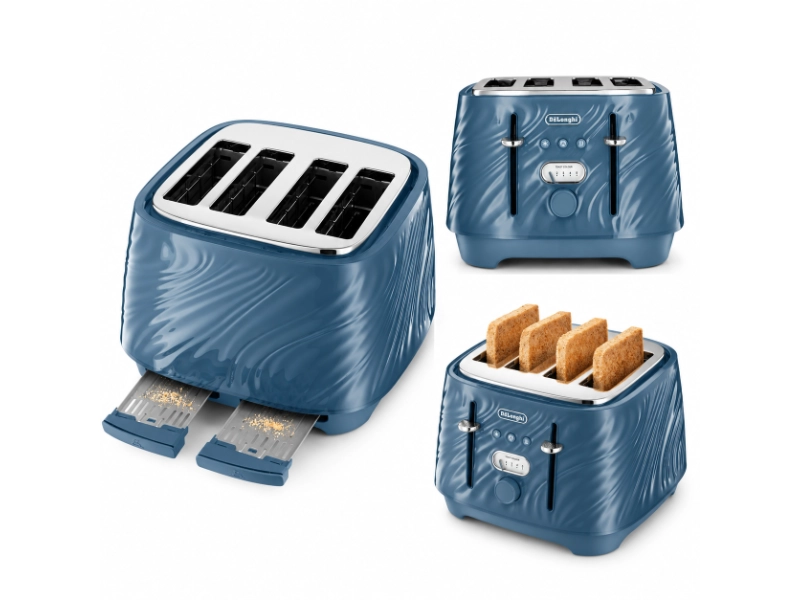
This toaster suits buyers who want 4-slice capacity without settling for a purely functional-looking appliance.
The De’Longhi Ballerina Seta (also available in cream) strikes a useful balance. It is noticeably more design-led than an entry-level toaster, but its appeal isn’t limited to the patterned finish.
The four slots are extra-wide and deep, with self-centring racks. This gives it more flexibility when you move beyond standard supermarket slices to thicker-cut bread, buns or hand-cut loaves. An extra-lift feature also helps with smaller items that would otherwise force you to reach uncomfortably close to the heating elements.
There are progressive electronic browning controls plus defrost, reheat and cancel functions. As is the norm with De’Longhi, a matching Ballerina Seta kettle makes this an especially strong option for a kitchen where the small appliances are always on show.
What you need to know is that some of what you’re paying for is clearly the Ballerina Seta design. The outer body also uses decorative plastic rather than being an all-metal toaster. If appearance isn’t important, you can buy four-slice capacity for considerably less.
Philips HD2637/91: Best Affordable 2-Slice Toaster
This toaster is best for straightforward everyday toasting, particularly if you sometimes buy thicker bread.
The Philips HD2637/91 is the kind of inexpensive toaster that makes you question whether you really need to spend more.
Its most useful feature isn’t the 7 browning levels. It’s the slot design. Philips specifies slots that are 10% wider than on its previous model, giving thicker slices more room while still letting the toaster centre thinner bread.
There’s also a built-in rack above the slots for warming rolls, buns and pastries. That’s unusual at this price and genuinely useful if breakfast in your house involves more than sliced bread.
Defrost and reheat functions cover the everyday basics, while the removable crumb tray makes cleaning straightforward.
What you need to know is that it’s still a conventional 2-slot toaster. Wide slots help with thick sourdough, but they don’t solve the problem of a very long slice. If your bakery loaf regularly sticks several centimetres above an ordinary toaster, consider a long-slot model instead.
Kenwood TCM37.000BK: Best Everyday 2-Slice Toaster

This toaster is best for a first home, couple or smaller household that wants something a little smarter than a basic plastic toaster.
Kenwood’s TCM37 is a relatively simple machine, but there are some good details behind the matt stainless-steel finish.
It has 7 browning levels, self-centring slots, and electronic timing, plus reheat, defrost, and stop controls. An anti-jam function and automatic switch-off add reassurance if a misshapen slice gets caught.
The bigger reason to choose it over cheaper options is that Kenwood sells matching matt-finish kettles in black, white and champagne. So, this is an easy way to put together a coordinated breakfast set without moving into Smeg or De’Longhi pricing.
What you need to know is that it doesn’t have a dedicated warming rack or the long slots needed for oversized artisan slices. Buy it for conventional everyday bread, good controls and the matching finish rather than unusual bread-handling ability.
Russell Hobbs Nexus RHPT4: Best Affordable 4-Slice Toaster
This toaster is best for families who need four slots more than they need premium detailing.
A lot of 4-slice toasters jump sharply in price. The Russell Hobbs Nexus RHPT4 keeps the proposition simpler: four long, wide slots, 7 browning settings, bread centring and the usual defrost, reheat and cancel buttons.
It also has integrated cord storage, which sounds minor until you realise how much neater it looks without a loop of spare cable behind it.
At just over 40cm long, however, this is no tiny appliance. Check the available counter space before assuming this four-slice toaster will fit where your old two-slice model sat.
The controls aren’t the sophisticated part of this toaster; capacity and value are. But if two people in the house regularly want very different browning levels at the same time, we’d lean towards a model with clearly independent controls for each pair of slots.
Bosch DesignLine TAT5P445GB: Best 4-Slice Toaster for a Busy Household
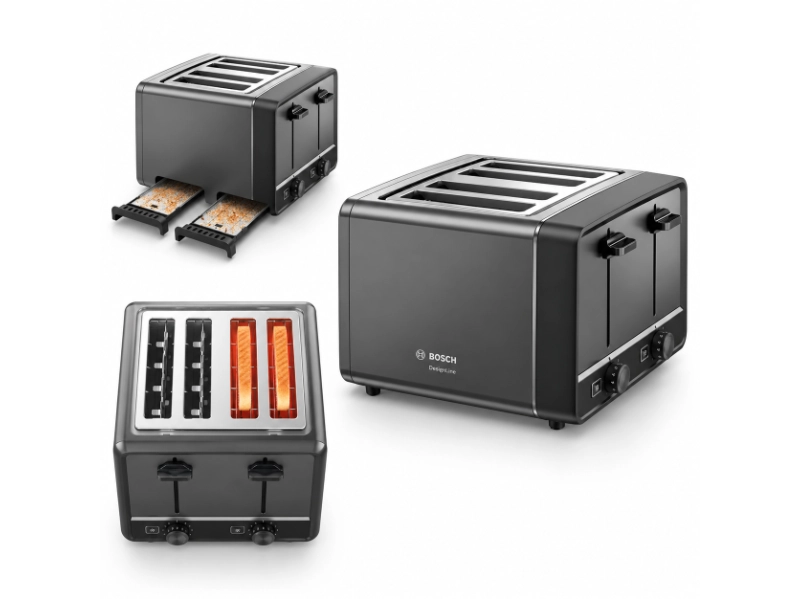
This toaster is best for couples and families who don’t all agree on what properly toasted means.
Four slots are useful, but two independently controlled pairs of slots are better.
The Bosch DesignLine 4-slice toaster lets each toasting chamber operate separately, so one person can have pale toast while somebody else takes theirs several shades further. You can also run only the pair you need rather than heating all four slots for a single breakfast.
Bosch uses electronic sensing and automatic bread centring to help keep results consistent. It includes defrost and reheat modes, plus cord storage and removable crumb trays.
What you need to know is that the toaster is about 30cm wide and 28.5cm deep, so those four conventional slots occupy a fair patch of counter. If you mainly need capacity for long sourdough rather than four separate sandwich slices, a long-slot design may use the space more effectively.
Zwilling Enfinigy ZW-1026860: Best Long-Slot Toaster

This toaster is best for sourdough, artisan loaves and anyone tired of turning a long slice around halfway through.
Here’s where slot design matters more than an extra programme button.
The Zwilling Enfinigy long-slot toaster takes either four conventional slices or two long pieces of bread. Its 40.7cm body is long, but only 16.8cm wide, so it occupies the counter differently from a chunky four-slot model.
Zwilling also does something interesting with repeated batches. The toaster automatically shortens subsequent cycles to compensate for the already-hot heating elements. That’s exactly the sort of feature you won’t notice on a specification comparison but can appreciate when the second round otherwise comes out much darker than the first.
There are 7 browning levels, reheat, defrost and bagel programmes, plus a soft-lift mechanism rather than an aggressive spring-loaded pop. The supplied bun warmer sits above the toaster for rolls or pastries, while a re-lift function helps retrieve smaller pieces.
At this price, it needs to solve a problem you genuinely have. If you only buy conventional sliced bread, much of its advantage disappears.
Smeg TSF01: Best Premium 2-Slice Toaster
This toaster is best for buyers who want the classic Smeg look but still expect strong toasting performance.
The Smeg TSF01 is expensive for a two-slice toaster. Happily, there is more going on here than a retro shell and a logo.
Independent RTINGS testing found the TSF01 quick and notably even, with long, wide and deep slots that cope well with thicker bread. Its bagel mode genuinely switches off one set of heating elements, so the cut face can brown while the outside stays softer.
It also has 6 browning levels, defrost and reheat settings, and a stainless-steel body. The broad choice of colours and readily available matching Smeg kettles is a large part of the appeal.
It’s larger and heavier than you might expect from a 2-slice toaster, and independent testing found that some crumbs can escape the tray. It also has no countdown or lift-and-look system. You are paying a substantial premium for Smeg’s design and finish, even though its tested toasting performance is genuinely good.
Smeg TSF03: Best Premium 4-Slot Toaster
This toaster is best for a larger household that wants proper four-slot flexibility and isn’t trying to hide the toaster in a cupboard.
If you’re buying a 4-slice toaster because two people often make breakfast at the same time, the Smeg TSF03‘s independent controls matter more than its retro looks.
Each pair of slots can be run separately. That means different browning levels on either side or only using two slots when that’s all you need. The slots are also generous enough for thicker artisan bread and bagels.
The substantial build gives the TSF03 a much more permanent feel than a lightweight budget toaster. And permanent is probably the right word. This is the kind of appliance you buy to leave on the counter, ideally alongside its matching kettle.
What you need to know is that it’s heavy, takes up plenty of room and can become quite hot on the outside. It’s also expensive enough that buyers should care about the appearance as much as the toast. If all you want is four slices of breakfast toast as cheaply as possible, the Bosch or Russell Hobbs makes more sense.
Best 2-Slice Toaster: Who Should Buy One?
For one person, a couple or a household where breakfast happens at different times, a two-slice toaster remains the sensible default. It’s generally cheaper and takes up less counter space than a conventional four-slot machine.
Don’t assume all 2-slice models are equally compact, though. Premium toasters can have wider, deeper housings to accommodate thicker bread, and some take up almost as much counter depth as a 4-slice model.
Our value pick is the Philips HD2637/91, particularly for its wide slots and bun rack. Spend more on the Smeg TSF01 2-slice toaster if you want a premium finish or have the matching kettle.
Best 4-Slice Toasters: Capacity Isn’t the Whole Story
A four-slice toaster makes obvious sense for families, but look closely at how those four slots operate.
Some models use one set of controls for everything. Others effectively give you two 2-slice toasters in the same body, with independent browning settings on either side. The latter is far more useful if different people use the toaster at once.
For that reason, the Bosch DesignLine is our practical family pick. The De’Longhi Ballerina Seta makes a stronger choice if design and extra-wide, deep slots are priorities, while the Smeg TSF03 pushes further into premium territory.
If you’re buying four-slice capacity because your bread itself is unusually large, however, consider whether you really want four conventional slots at all.
Best Long-Slot Toaster: The Better Choice for Sourdough
Wide slots and long slots solve different problems.
Wide slots accommodate thick slices, bagels and chunky hand-cut bread. Long slots accommodate bread that’s simply too long for a normal toaster.
That makes a long-slot model one of the smartest upgrades for anyone who regularly buys bakery sourdough, slices bread from a large homemade boule or likes elongated artisan loaves.
The Zwilling Enfinigy ZW-1026860 is our top pick here because it combines true long-slot flexibility with the ability to take four conventional slices. Its compensation for repeated toast cycles is another meaningful differentiator.
The De’Longhi Diadema CTV3003.M is another attractive long-slot option at Hirsch’s, combining two extra-wide long slots with bagel, reheat and defrost functions.
Just measure first. A long-slot toaster may be slim, but it can stretch beyond 40cm from end to end.
What Makes a Good Toaster?
Even Browning Beats a Huge Settings Dial
Having 6, 7 or 11 browning positions sounds impressive, but the number means little if setting 4 gives you different results every morning.
A good toaster should be predictable. Once you’ve found the setting that works for your normal bread, you should be able to return to it without constantly peering into the slots.
Repeated batches are another useful test. Heating elements are already hot after the first cycle, so a basic toaster may darken the second batch more quickly. More sophisticated electronic timing can compensate for this, as the Zwilling does automatically.
Check the Slot Before You Check the Wattage
Wattage tells you something about the electrical power available to the toaster. It doesn’t tell you whether your bread will fit.
For most buyers, slot length, width and depth are more useful shopping criteria.
If you buy thick-cut sandwich bread or halve a bagel, look for wide slots. If you eat sourdough or bread from large artisan loaves, pay attention to length. A wide conventional slot may still leave the top of a long slice sticking out.
Self-centring racks are useful too. They bring thinner bread closer to the heating elements, rather than letting it lean against one side of an oversized slot.
Defrost, Reheat and Bagel Modes Aren’t the Same Thing
These buttons can look like feature padding, but the right ones are genuinely handy.
- Defrost is useful if you keep sliced bread in the freezer. It adjusts the cycle so you can toast from frozen rather than thawing first.
- Reheat gives cooled toast a short warming cycle without deliberately taking it another shade darker.
- Bagel mode needs closer inspection. On models such as the Smeg TSF01, it provides one-sided toasting. So, you can brown the cut surface of the bagel while leaving its outer crust softer.
Don’t Ignore the Crumb Tray
The crumb tray is rarely what sells a toaster, but it may become the bit you interact with most after the browning control.
A tray that slides out cleanly encourages you to empty it regularly. Check where it exits too. Rear-mounted trays can be awkward if your toaster sits pushed against a splashback or wall.
If you eat heavily seeded loaves, crumb management becomes even more noticeable. Seeds have an uncanny ability to find every gap the tray doesn’t cover.
Stainless Steel Isn’t Automatically Better Than Plastic
A stainless-steel toaster can feel more substantial and may suit a modern kitchen better, but plastic isn’t automatically a sign of a bad toaster.
It can keep weight and price down, and a textured or coloured plastic body may hide fingerprints more effectively than polished metal.
Stainless steel has its own annoyances. Glossy or brushed finishes can show fingerprints and smears, while metal surfaces may become hot during repeated use.
Buy the construction that makes sense for the price and where the toaster will live rather than treating stainless steel as shorthand for quality.
Cord Storage Is Boring Until the Toaster Is on Your Counter
A built-in cord wrap or storage channel won’t improve your breakfast, but it can make a surprisingly large difference to a tidy kitchen.
This is especially useful when the power point sits directly behind the appliance. Instead of having 60cm of cable coiled on the worktop, you can leave out only what you need.
A Matching Kettle and Toaster Can Be Worth Paying For
Sometimes the sensible toaster isn’t the one that wins purely on price.
If you’re furnishing a first home, buying a wedding gift or replacing two tired small appliances at once, a matching kettle and toaster can make a kitchen feel put together.
Hirsch’s carries several coordinated ranges. Kenwood’s matt black, white and champagne finishes offer a relatively affordable route to the matching look. Russell Hobbs has breakfast packs that bundle a kettle and toaster together, while De’Longhi’s Ballerina Seta range pushes the idea further with its sculpted patterned finish.
Then there is Smeg. A significant part of the appeal of its toasters is that you can match them with a kettle in cream, black, red, pastel blue and other finishes. If those appliances are permanently visible in an open-plan kitchen, paying for a look you enjoy every day is a perfectly reasonable buying decision.
It just helps to be clear about what you’re buying. A R4,000 toaster does not make toast four times better than an R1,000 toaster. It may toast very well, but some of that price buys materials, design and a coordinated counter.
Which Toaster Should You Buy?
For most buyers, the decision can be made quickly:
- Choose a 2-slice toaster if one or two people use it at a time and counter space is limited.
- Choose a conventional 4-slice model for families, especially if each pair of slots can operate independently.
- Choose a long-slot toaster if sourdough, bakery bread or homemade loaves regularly don’t fit your current machine.
- Spend more for better construction, useful bread-handling features or a design you genuinely want on display.
- Save your money if all you need is dependable toast from ordinary sliced bread.
Frequently Asked Questions
What brand of toaster is the best?
There isn’t one toaster brand that is best for every buyer. Philips and Kenwood offer strong everyday options at lower prices, while Bosch and Russell Hobbs make practical 4-slice choices. De’Longhi, Zwilling and Smeg become more interesting if you want unusual slot designs, premium finishes or matching appliance collections. Compare the individual model rather than buying on the badge alone.
Which toasters last the longest?
There isn’t enough comparable long-term reliability data to say that one current toaster will definitely outlast another. A higher price isn’t proof of a longer lifespan either. Look for solid controls and levers, a sensible warranty and a design that is easy to keep clean. Owner reviews can also reveal recurring problems that won’t appear on a spec sheet.
How do you pick a good toaster?
Start with how many slices you normally make at once and the bread you eat. Then check the slot dimensions, browning control, crumb-tray access and whether functions such as defrost, reheat or one-sided bagel toasting are genuinely useful to you. Cord positioning and a cord storage channel can be important. Finally, check the toaster’s physical dimensions. Four slots or extra-long slots can take up more worktop than expected.
Which brand of toaster is the most reliable?
Reliability can vary between models from the same brand, so we’d be wary of naming one manufacturer as universally the most reliable without comparable failure-rate data. Established brands including Bosch, Philips, Kenwood, Russell Hobbs, De’Longhi, Smeg and Zwilling all offer current models at Hirsch’s. Look at the warranty and the track record of the individual model alongside its features.
Is a 4-slice toaster worth it?
Yes, if you regularly make three or four slices at once. It’s especially useful for families and shared kitchens. Ideally, choose a model with two independently controlled sides so you can toast different breads or browning levels at the same time. If four-slice capacity is only needed occasionally, the additional counter space may not be worth it.
What is the best toaster for sourdough?
For long artisan sourdough slices, we’d choose a long-slot toaster such as the Zwilling Enfinigy ZW-1026860. It can take two long pieces or four ordinary slices. For thick but conventionally shaped sourdough, an extra-wide standard toaster may be enough. Check both slot width and length, since they solve different fit problems.
Is an expensive toaster really better?
Sometimes, but not in direct proportion to the price. More expensive models may offer more even browning, stronger construction, long or extra-wide slots and better controls. Premium finishes and matching kettle ranges also add to the price. If you mainly toast ordinary sliced bread, a good affordable model can do the job perfectly well.
Find the Right Toaster for Your Kitchen
The best toasters fit the bread you eat, make enough slices for your household, and deliver repeatable results without unnecessary fuss. From a simple 2-slice replacement to a long-slot sourdough specialist or a matching statement piece for the counter, choose the features you’ll notice after the novelty has worn off.
Shop Hirsch’s toaster range online, explore matching kettle-and-toaster options or visit your nearest Hirsch’s store to compare the size and finish in person.