
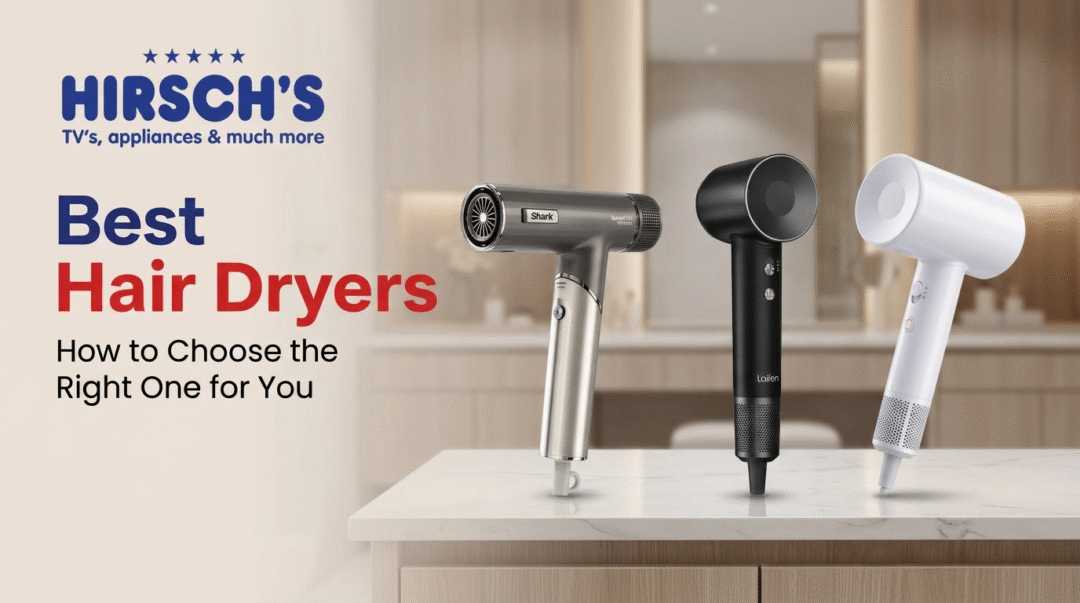
If you have fine hair, tight curls, thick hair, or hair that’s already dry or damaged, you’re looking for something different from a hair dryer.
For some people, the priority is getting through a lot of hair without spending half the morning drying it. For others, it’s keeping curls defined, avoiding too much heat or finding a dryer light enough to use comfortably with a brush. The right attachments can be almost as important as the motor, especially if you diffuse, stretch or smooth your hair regularly.
That’s why it’s better to compare hair dryers by hair type than by price or wattage alone. Browse hair dryers at Hirsch’s, then look for features that match how you dry and style your hair.
The Best Hair Dryers Depend on Your Hair Type
It’s tempting to compare hair dryers by wattage or price and to assume that bigger buys better performance.
A useful dryer needs the right combination of airflow and heat for your hair, with enough control to avoid using more heat than necessary. Attachments become particularly important if you diffuse curls, stretch coily hair or use a round brush for a smooth blowout.
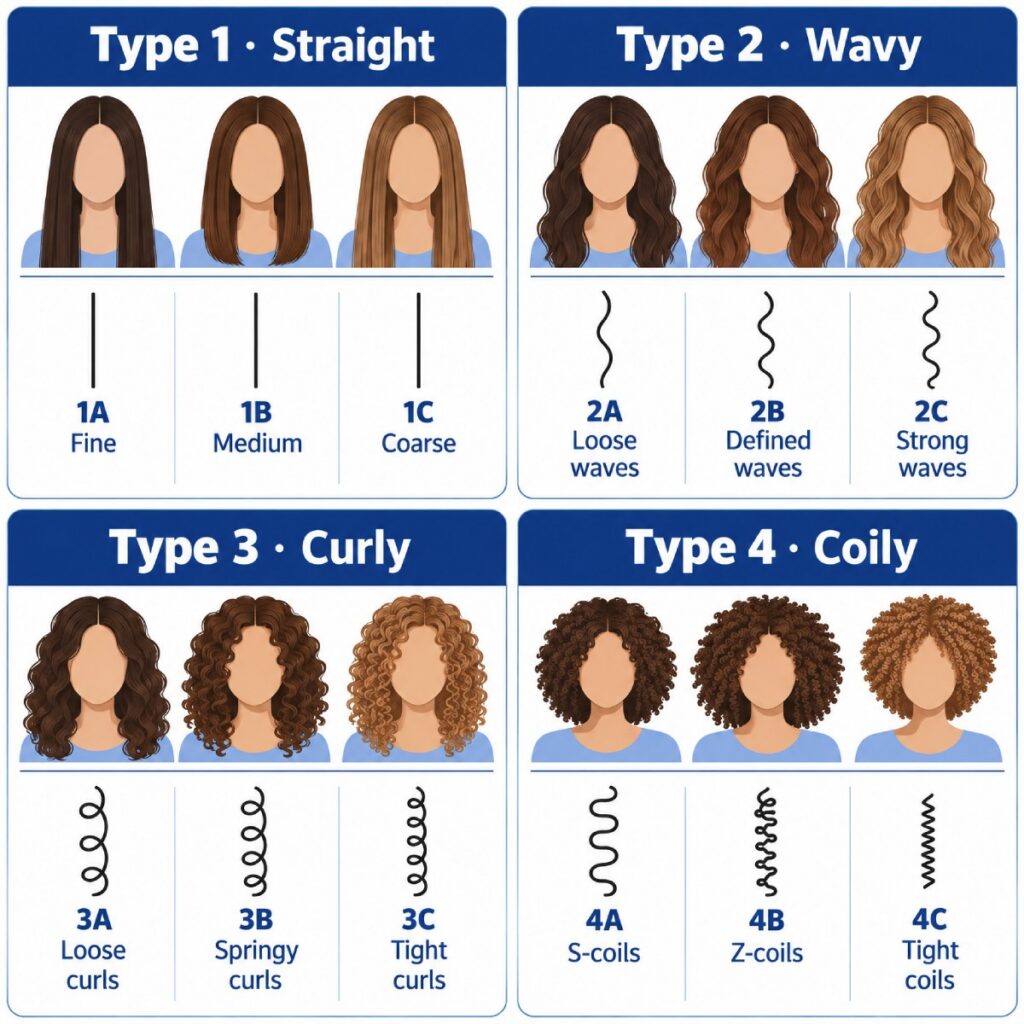
| Hair Type or Need | What to Prioritise | Useful Attachments | Watch Out For |
|---|---|---|---|
| Fine or thin hair | Adjustable heat, controlled airflow and low weight | Concentrator | Excessive heat or airflow that flattens volume |
| Curly or wavy hair | Lower speed settings, diffuser and good heat control | Diffuser | Narrow, forceful airflow that breaks up the curl pattern |
| Coily or 4C hair | Strong airflow with temperature control | Diffuser and wide-tooth comb | Assuming maximum heat is necessary for stretching |
| Thick or long hair | High airflow and comfortable balance | Concentrator | A heavy dryer that becomes tiring during a long session |
| Dry, damaged or colour-treated hair | Lower usable temperatures and good heat regulation | Concentrator or diffuser | Assuming ionic or ceramic technology makes high heat harmless |
These priorities overlap. If your hair is both fine and curly, for example, you’ll probably want a lightweight dryer with low heat and speed settings and a good diffuser.
Ionic, Ceramic and Tourmaline Hair Dryers Explained
The technology labels printed on the box can make choosing a dryer sound more complicated than it needs to be. They’re worth understanding, but none should outweigh the basics: heat control, airflow, and a suitable attachment.
Ionic Hair Dryers
Ionic dryers produce negatively charged ions and are commonly designed to reduce static and help hair dry efficiently. They’re particularly appealing if you’re trying to create a smooth finish or control visible frizz.
That doesn’t make ionic technology the automatic winner for everybody. Fine hair that already lies flat may benefit more from careful airflow and styling technique than from a dryer focused heavily on smoothing.
Ceramic Hair Dryers
Ceramic components help distribute heat more evenly. That can make temperature control more consistent than with a very basic heating system, especially when you’re moving the dryer around different sections of your hair.
But ceramic components don’t mean you can ignore the heat setting. A ceramic dryer can still get hot enough to damage your hair if you use it at maximum temperature for too long.
Tourmaline Hair Dryers
Tourmaline is a mineral used in some dryers to help generate ions. You’ll often see it marketed around smoother hair, reduced static and faster drying.
Treat it as an extra feature rather than a reason to buy a dryer on its own. A tourmaline model with poor heat control or the wrong attachments is unlikely to suit you as well as a simpler dryer that gets those basics right.
Wattage Isn’t the Same as Drying Power
Wattage measures electrical power consumption, but it doesn’t tell you how quickly the machine will dry your hair.
A well-designed 1,600 W dryer can move air effectively, while a higher-wattage dryer may rely more on heat. Motor design, fan speed, and the shape of the airflow path all affect performance.
When a manufacturer gives an airflow figure, usually in litres per second or cubic metres per minute (m³/min), it can be a more useful way to compare. Dyson, for example, lists its Supersonic Nural Curly & Coil Hair Dryer at 1,600 W with airflow of 13.3 L/s.
The ideal is strong enough airflow to move moisture away efficiently without compensating with excessive heat. For thick or long hair, that can make a noticeable difference to how practical the dryer feels.
Heat Settings, Speed Settings and the Cool Shot
Separate heat and speed controls give you more flexibility than a dryer where hotter automatically means faster.
For fine, damaged, or colour-treated hair, keeping the airflow reasonably strong while dropping the temperature can be particularly useful. Curly hair may call for the opposite adjustment when diffusing: lower airflow helps avoid blowing curls apart, while you can choose the heat setting separately.
A cool shot sends unheated or cooler air through the dryer. It’s useful towards the end of styling, particularly after using a brush to create shape. Think of it as a finishing control, not a feature that can undo excessive heat used earlier in the process.
And more settings aren’t automatically better, either. Three well-chosen temperatures you can change easily may be more useful than a long menu you never touch.
Best Hair Dryers for Fine Hair
Fine hair calls for control, not brute force.
If your roots tend to collapse after drying, look for variable airflow so you don’t have to blast every section at full speed. Lower heat settings help too, especially if your hair is bleached, coloured, or prone to breakage.
Weight matters if you use a round brush. Holding the dryer above your head while controlling the brush is where the difference starts to show.
The Laifen SE Lite High Performance Hair Dryer is compact and weighs only 407 g without the cord. It offers hot, warm, and cool settings plus a temperature-cycling mode, and the included smooth nozzle suits directed drying more than curl diffusing.
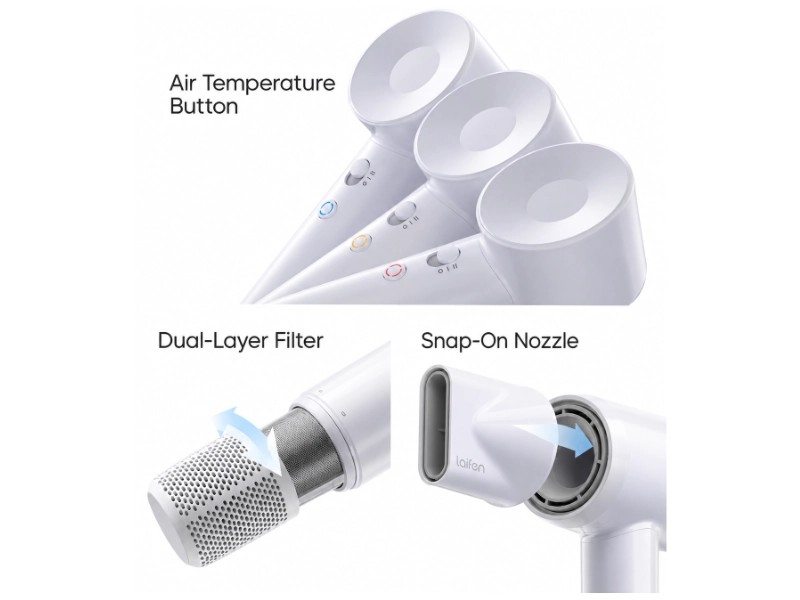
For fine hair, look for manageable heat, adjustable speed, low weight and a concentrator that lets you put the airflow where you need it.
Best Hair Dryers for Curly and Coily Hair
Curly and coily hair needs a little more thought because the best attachment depends on the finished style you want.
If you’re preserving your natural curl pattern, start with the diffuser. Instead of concentrating air into a narrow stream, a diffuser spreads it over a wider area. Lower airflow can help dry curls without pushing them around as aggressively.
Look at the diffuser itself rather than simply checking whether one is included. The bowl size and prong length can affect how comfortably it handles your curl length and density.
For coily hair, especially tighter Type 4 textures, a wide-tooth comb attachment can help you stretch or lengthen the hair as you dry it. You still want control over temperature; stretching does not require turning the dryer to maximum heat by default.
The Dyson Supersonic Nural Curly & Coil Hair Dryer is unusually well equipped in this respect. Its attachment set includes a Wave+Curl Diffuser and wide-tooth comb, along with its styling concentrator and gentle dryer attachment. It also offers four temperature levels, from cool drying to its hottest fast-drying setting.
For a less expensive alternative with a conventional dryer format, the Laifen Swift Special High Speed Hair Dryer includes a diffuser, concentrator and smooth nozzle.

Best Hair Dryers for Thick or Long Hair
With more hair to dry, airflow moves higher up the priority list for thick or long hair.
A dryer that pushes a substantial volume of air can reduce the temptation to compensate by holding very hot air on each section for longer. A concentrator helps when you move from rough drying to controlled brush styling.
The catch is weight. Dense or long hair usually means a longer drying session, so a dryer that looks impressively solid in the box can become uncomfortable after several minutes.
The Shark Speedstyle Pro Flex 4-in-1 High Performance Hair Dryer is one model aimed at this high-airflow end of the market. It’s powered by a high-speed motor and combines the dryer with a Turbo Concentrator, QuickSmooth Brush, diffuser and finishing attachment. Its folding handle also helps when storage space is tight.
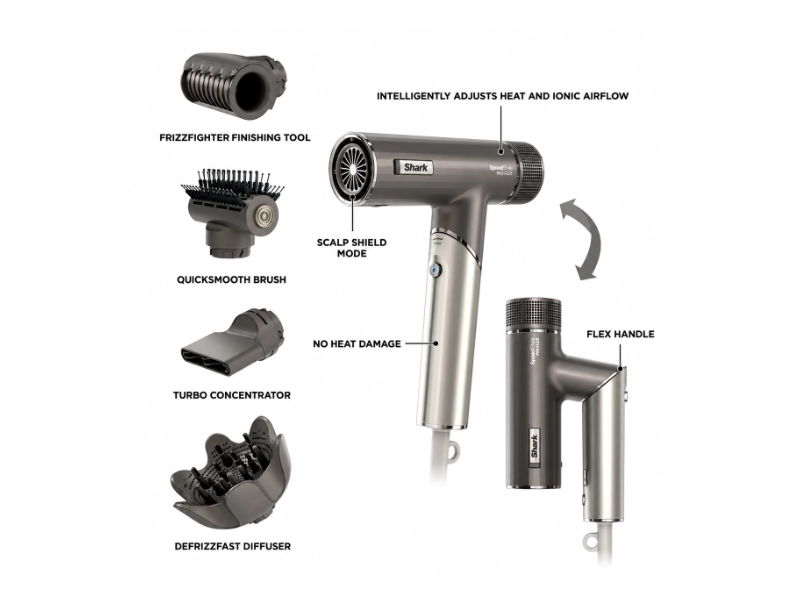
For thick curly hair, pay equal attention to the diffuser. Raw airflow helps only if you can control how it reaches the hair.
Weight and Balance Are More Important Than You Think
Hair dryer weight is easy to dismiss until you’re halfway through styling the back of your head.
It matters most if you have long or dense hair, diffuse with your head tilted, or regularly use a round brush. In these situations, you’re not simply holding the dryer; you’re repeatedly lifting, rotating and repositioning it.
Published weight gives you a useful starting point. The Laifen Swift Special weighs 407 g, the Dyson Supersonic Nural Curly & Coil 0.65 kg, and the Shark Speedstyle Pro around 0.68 kg.
Balance also counts. A well-balanced dryer can feel easier to manoeuvre than a similar model, so it’s worth assessing in person when you can.
Hair Dryer Attachments Worth Having
A box full of attachments is good value only if they match how you style your hair.
Concentrator
A concentrator narrows and directs the airflow. It’s particularly useful for brush styling, smoothing individual sections and working around shorter layers without sending air everywhere else.
Diffuser
A diffuser spreads the airflow over a larger area. It’s the main attachment to look for if you wear curly or wavy hair and want to dry it while keeping the natural pattern intact.
Wide-Tooth Comb
A comb attachment directs air through textured hair while the teeth help separate and stretch sections. It can be especially useful for coily hair before further styling or when you want a longer finish.
Brushes, flyaway tools and curling attachments can be valuable too, but they move a dryer closer to the territory of a multi-styler. Products such as the Shark FlexStyle 5-in-1 Air Styler & Hair Dryer make more sense if you want those styling functions rather than just a fast hair dryer with a nozzle. Its attachment set includes paddle and oval brushes, a concentrator, diffuser and curling tools.
Don’t Ignore Hair Dryer Noise
Hair dryers are noisy appliances, but some are easier to live with than others.
The difficulty is comparing them. Manufacturers don’t always publish a decibel figure, and figures from different brands aren’t necessarily measured under identical conditions.
Where a reliable specification is provided, it gives you something useful to consider alongside weight and performance. The Laifen Swift Special claims 59 dB, while the Dyson Supersonic Nural Curly & Coil and the Dreame Glory Mix Hair Dryer claim 77 and 76 dB respectively. Those figures come from each product’s published specifications, so treat them as individual product information rather than a controlled head-to-head noise test. But motor pitch also affects how loud or irritating a dryer sounds in the bathroom, which an in-store demonstration can show better than a product write-up.
A Better Hair Dryer Can Help You Manage Heat, Not Make Heat Harmless
Features such as ceramic heating, temperature sensors and intelligent heat controls can give you better control over how much heat reaches your hair. Strong airflow can also help because drying doesn’t have to depend on temperature alone.
But none of that makes repeated high heat harmless.
A smarter approach is to use the lowest temperature that gets the job done in a reasonable time, keep the dryer moving so it doesn’t concentrate heat on one small area, and adjust the settings to your hair’s condition.
If limiting heat exposure is a priority, pay more attention to the controls available to you than to a single ionic, ceramic or tourmaline badge.
Is the Dyson Supersonic Worth the Extra Cost?
The Dyson question comes up because the Supersonic sits well above many conventional hair dryers in price, yet you can now find high-speed alternatives offering similar features.
Dyson offers a particularly well-developed combination of airflow control, temperature settings, sensors, attachment design, and ergonomics. The Curly & Coil version is also one of the best examples of a premium dryer designed specifically for textured hair, rather than adding a basic diffuser as an afterthought.
However, you don’t have to spend Dyson money to get:
- ionic technology
- multiple heat settings
- a cool setting
- a diffuser
- strong high-speed airflow
- a lightweight body
The Laifen Swift Special, for example, combines a 1,600 W motor with multiple attachments, temperature regulation and a much lighter published weight, while the Shark SpeedStyle Pro Flex offers a high-speed motor and four styling attachments.
So, is the Dyson worth it? It makes the strongest case if you dry your hair frequently, use its more specialised attachments, and value heat controls and overall handling.
If you mainly need to dry your hair after a wash and use one or two basic settings, alternatives can cover those fundamentals without the premium price.
How to Choose a Hair Dryer in 60 Seconds
If you’ve narrowed the range down but still aren’t sure which model to buy, work through these five points:
- Start with your hair type. Fine, curly, coily and thick hair don’t all need the same airflow or attachments.
- Compare the heat and speed controls. More control is generally more useful than a bigger wattage figure.
- Check the attachments you’ll actually use. A diffuser matters far more to a curl wearer than five styling pieces that stay in a drawer.
- Look at the weight. It becomes increasingly important as drying and styling time increases.
- Decide how much styling the dryer needs to do. A straightforward dryer may be enough, while a FlexStyle-type multi-styler makes more sense if you regularly curl, smooth and shape with hot air.
Frequently Asked Questions
What hair dryer do you recommend most?
No single hair dryer is the best choice for every hair type. A good general-purpose model should offer strong airflow, several heat and speed choices and comfortable handling. Curly or coily hair also makes a good diffuser or comb attachment a much higher priority, while fine hair benefits from particularly good lower-temperature control.
Which hair dryer is best for home use?
For most homes, look for a dryer with adjustable heat and airflow, a cool setting and at least one useful concentrator. You don’t necessarily need the power, long cord, or heavy-duty construction found in professional salon dryers. If several people share the dryer, choose a versatile model with enough control for different hair types.
What hair dryers do professional hairdressers use?
Professional hairdressers use many different brands, but salon dryers tend to prioritise strong, sustained airflow; reliable heat control; durability; long power cords; and concentrator nozzles that make section-by-section styling easier. What works best in a salon isn’t automatically the best home dryer, particularly if you’d prefer something smaller and lighter.
Is an ionic hair dryer better for curly hair?
Ionic technology can help with smoothness and static control, but it isn’t the main feature to focus on when choosing a dryer for curls. A well-designed diffuser, controllable airflow and suitable heat settings have a more direct effect on how easily you can dry your hair without blowing the curl pattern apart.
Is a 2,000 W hair dryer better than a 1,600 W hair dryer?
Not necessarily. Wattage tells you how much electrical power the dryer uses, not exactly how much air it moves or how efficiently it dries hair. Motor design, airflow, and heat management all affect performance, so a well-designed 1,600 W high-speed dryer can match or outperform a higher-wattage model in everyday use.
Find the Right Hair Dryer for Your Hair
The best hair dryers give you the airflow, temperature control, and attachments your hair needs, without making you pay for features you’ll rarely use. Compare Hirsch’s hair-care range online, or visit your nearest store to get a better sense of a dryer’s weight, balance, and attachments before choosing.
No Comments